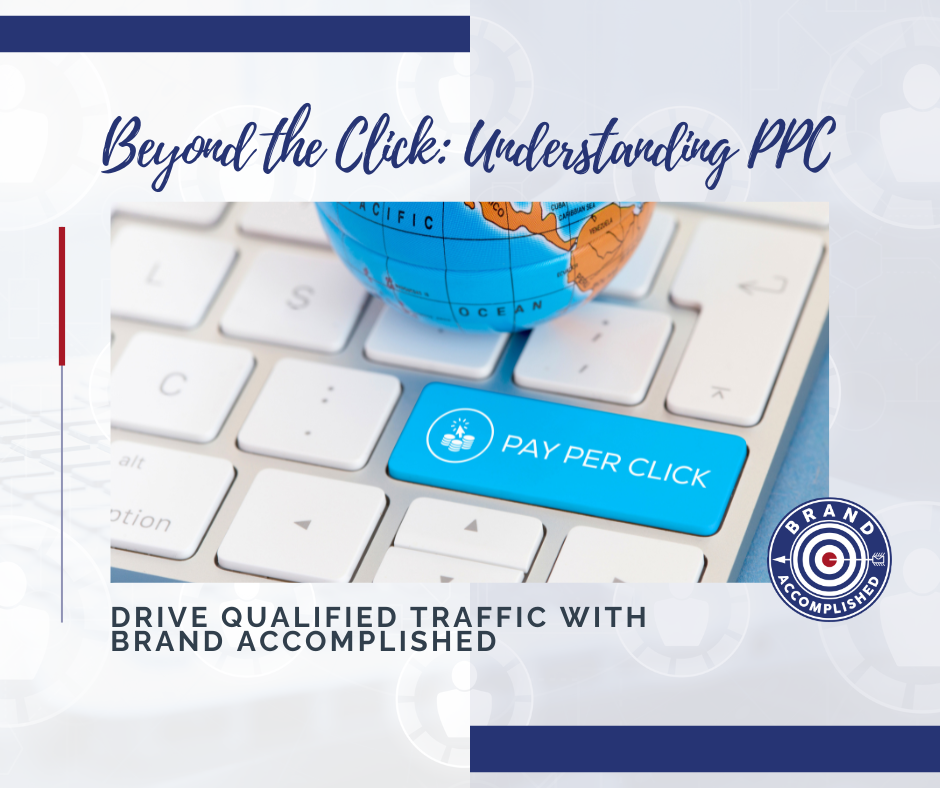
Beyond the Click: Understanding Pay-Per-Click (PPC) Advertising
To get people to your site is great; to get the right people there is what really counts.
Pay-per-click (PPC) advertising is a means by which businesses can place their products/services in front of individuals who are currently searching for something offered by their company. As opposed to "hopping" that customers will eventually find your website, paid advertisements can help you reach them at the right time.
In addition to being able to reach the right people, with pay-per-click (PPC), you can also determine how much you wish to spend, whom you wish to target, and what actions you wish users to perform once they click on your advertisement.
Of course, securing a click is merely the first step in creating a successful PPC campaign. To successfully run a PPC campaign, you will require appropriate keywords, a realistic budget, relevant advertisements, and consistent monitoring to ensure that all of those clicks are ultimately beneficial to your company.
POST SUMMARY
What is Pay-Per-Click (PPC) Advertising?
PPC is a form of internet-based advertising whereby companies pay for every time an individual clicks on their advertisement. This form of advertising is commonly used in search engine results pages (SERPs). PPC is designed to enable companies to advertise their products/services to individuals actively seeking the same through search engines.
What topics does this article address?
The article provides a general overview of PPC, focusing upon its mechanics, establishing a budget, the impact of keywords upon campaigns, the advantages of focusing on a specified audience, and determining whether or not your advertising efforts are generating returns.
Who would benefit from the information contained in this blog article?
Any business owner(s)/marketing professional(s) wishing to draw more qualified visitors to their website, enhance their internet presence, and obtain greater value from their advertising expenditures can benefit from an understanding of how PPC operates.
PAY-PER-CLICK (PPC) ADVERTISING BASICS
Chances are good that you've viewed numerous PPC ads without even thinking twice about them.
Assume someone conducts a search for a product/service you provide. In addition to the standard search results returned by the search engine, they may view an advertisement for your company. If your ad captures their attention and they choose to click it, they will be directed to your website/landing page.
Once clicked, you will pay for that click. However, PPC is not simply about generating additional visitors to your website. The ultimate goal is to reach people who truly possess a legitimate justification for visiting your website.
There are several components involved in developing a standard PPC campaign:
- Clearly defined advertising objective
- A clearly defined target audience
- Relevant keywords
- Advertisements that appeal to the needs of customers
- A useful landing page
- Established budget
- Continual performance monitoring
When all of these elements are properly integrated, PPC has the capability to convert internet searchers into visitors to your website, and subsequently generate inquiries/appointments/purchases.
ESTABLISHING A PPC BUDGET THAT IS APPROPRIATE FOR YOU
Establishing a budget for your PPC campaign is not required for you to utilize PPC. One of the greatest benefits of PPC is that you establish the amount of money you are willing to commit. The key factor is ensuring that your established budget supports the objectives that you are attempting to attain.
Prior to establishing a budget, consider the following factors:
- The objectives you hope your campaign achieves
- How competitive your industry is
- What price businesses in your industry typically pay for similar clicks
- Where you desire to focus geographically
- Products/services you plan to promote
- The perceived value of acquiring a new customer or lead
Your budget may vary from month-to-month. PPC campaigns provide valuable insights that demonstrate where your dollar is producing the best results. For instance, if one campaign continually generates high-quality leads while another produces clicks without corresponding action, you can allocate funds according to how effective both campaigns were.
SELECTING KEYWORDS USED BY YOUR CLIENTS
Selecting keywords appears relatively straightforward; however, selecting the correct keywords for your PPC campaign represents one of the most critical aspects of running a successful campaign.
Keywords selected to represent your company may not reflect the exact phrases your clients enter into a search engine. Recognizing how your client base searches will significantly contribute to success in your PPC campaign.
When selecting keywords, consider the following:
- Closeness of the keyword to representing your service/product
- Intentions of the searcher utilizing the keyword
- Should geographic location be included
- Frequency at which people search using that keyword
- Competition levels associated with the keyword
- Potential costs per click related to the keyword
- Possibility that a longer descriptive phrase would attract a more desirable prospect
Simply accumulating as many clicks as possible is not always ideal. Although obtaining hundreds of visitors from a broad keyword may seem impressive; if those visitors are largely uninterested in purchasing or engaging in some form of interaction with your company; then acquiring those visitors may not yield positive results. Conversely, although fewer visitors may result from utilizing a more precise search term; those visitors may be substantially more likely to engage in some form of interaction with your company.
Ultimately, quality traffic is preferred over quantity traffic.
TARGETING THE RIGHT AUDIENCE THROUGH ADVERTISING
Another primary purpose for why businesses opt for PPC is because of the ability to selectively identify who views their advertisements.
Based upon various platforms, campaigns can be targeted in terms of:
- Geographic location
- Keyword utilization/search patterns
- Interests
- Demographics
- Devices utilized
- Hours/day
- Prior website visitation history
As an example, if a local business wishes to avoid expending money for clicks originating from thousands of miles away; then geographic targeting enables them to focus their advertising efforts upon people living in regions where their business physically operates.
This degree of control enables businesses to maximize their advertising budget and create more productive advertising expenditures.
PPC can also be advantageous if you need immediate exposure. Businesses launching new products/services, offering seasonal promotions, etc., and/or need to develop awareness among customers during specific periods, can utilize paid advertising while awaiting organic awareness to accumulate over time.
MEASURING SUCCESS BY LOOKING BEYOND CLICKS AND CONVERSION METRICS
While seeing increased click-through rates may give you optimism; increased click-through rates indicate nothing regarding whether your campaign was successful.
What occurs immediately after the user clicks matters more. Do users contact you? Do users request quotes? Do users book appointments? Do users make purchases?
Some helpful metrics to monitor include:
- Impressions
- Clicks
- Click-through rate (CTR)
- Cost per click (CPC)
- Conversions
- Conversion rate
- Cost per conversion (CPA)
- Return on ad spend (ROAS)
Monitoring these metrics collectively provides a much clearer image of what transpires.
An example illustrating this concept: an advertisement receives considerable traffic; however, few users initiate contact. In this case, there could be multiple reasons why this occurred such as: the incorrect audience is clicking on the advertisement, the landing pages fail to answer user questions, or no connection exists between what users seek and what the advertisement proposes.
By regularly evaluating performance metrics for your campaigns, you can implement changes prior to continuing investing in ineffective strategies.
KEY TAKEAWAYS
PPC can place your company in front of customers immediately
Utilizing paid advertising allows your company to rapidly obtain visibility and begin driving visitors to your website without having to wait for organic traffic to develop.
Quality traffic is preferable over quality traffic
A successful PPC campaign does not rely solely upon collecting as many clicks as feasible. Its success lies in attracting viewers who have a sincere intention of engaging with what your company has to offer.
Budget and keywords function collectively
Determining an adequate budget combined with careful consideration regarding selecting optimal keywords will enable you to focus your advertising expenditure on search terms and audiences that have the highest potential.
DRIVE QUALIFIED TRAFFIC WITH BRAND ACCOMPLISHED
Pay-per-click advertising plays an important role in helping your business reach potential customers who are actively searching for your products or services.
At Brand Accomplished, we help businesses create targeted PPC campaigns, manage advertising budgets, select relevant keywords, and monitor performance to drive qualified traffic.
Reach the right audience at the right time and make more of your advertising budget.
Contact Brand Accomplished today to learn how our Pay-Per-Click (PPC) advertising services can help your business generate meaningful results.